Why Wooden Grain Makes Each Board Behave a Little Differently
Wooden grain explains why boards show marks, shed water and respond to handling differently, helping you choose sensible routines for each surface.
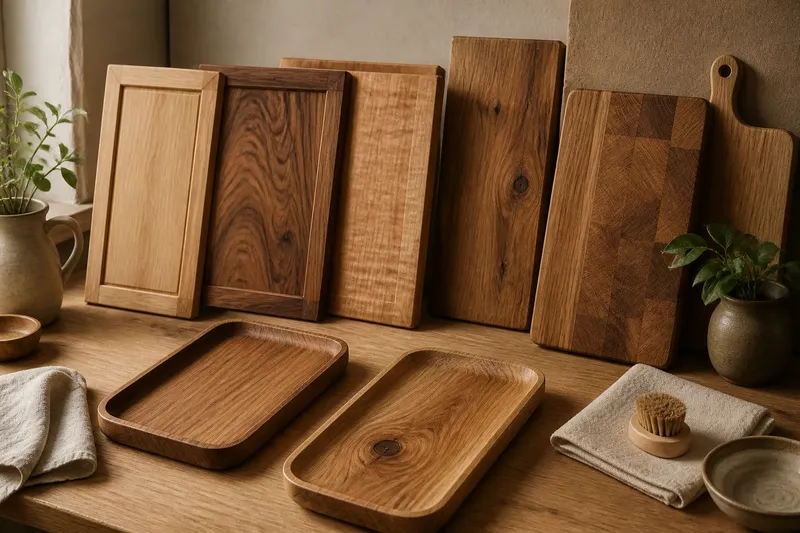
The common mistake with wooden grain is to treat every board as a uniform slab: wipe it, stack it and expect it to respond like its neighbour. That can leave one board looking worn sooner, or make a damp patch seem mysterious when the grain already hinted at how the surface would take up moisture. Reading the grain helps you match ordinary handling to the particular board in your home.
Read the surface
Grain is the visible pattern made by a tree’s growth and the way a piece has been cut from it. Lines may run lengthwise, curve into waves, or appear as arcs and rings. Knots, colour shifts and small irregularities are part of that pattern, not necessarily evidence of poor workmanship.
Look first at the broad face, then at a narrow edge. On the face, long lines often follow the board’s length; on the edge, they can reveal the layers and direction of the wood fibres. A board cut through a different part of the tree may show a different pattern even when it is made from the same species.
These visible lines matter because wood is made of fibres, and their direction influences how the surface responds to rubbing, moisture and everyday knocks. Think of a bundle of drinking straws: it is easier to split along their length than across them. Wood is more complex, but the analogy helps explain why a scratch or split may follow the grain rather than cross it.
Choose by use
If the board is a shelf or a small tabletop, focus on how its grain will look in the room and how its surface will be handled. A calm, fairly straight pattern can make scuffs less visually busy, while lively curves may draw the eye and show changes in light. Neither is inherently better; the right choice depends on whether you want the board to blend in or become a feature.
For a serving board or tray, consider the exposed edges as well as the top. End grain—the ends of the fibres—can look like short dashes or small blocks. It may absorb moisture differently from the long-grain face, so a spill can leave a more noticeable change there. A board with mixed grain can still be perfectly useful; it simply rewards prompt, even drying after ordinary use.
If the object is a drawer front or cabinet panel, check the direction of the pattern against the shape. Long, continuous lines can make a narrow piece seem composed, while a swirling section may stand out more. Grain does not dictate the furniture’s quality, but it can explain why two panels finished alike do not look identical.
What does grain change?
Why do some marks follow the grain?
Fibres offer a natural path across the surface, so shallow scratches often appear to run with the lines. A crosswise nick may be more conspicuous because it interrupts that pattern. The exact mark also depends on the wood, finish and object, so treat the grain as a clue rather than a prediction.
Why does one patch darken?
Wood can take up moisture unevenly where the grain, end grain or finish differs. A damp ring may therefore be more visible in one area than another, even on a single board. Let the surface dry in ordinary room conditions and follow the care directions for its finish before deciding whether it needs further attention.
Does a knot mean the board is weak?
A knot marks the place where a branch grew, and it changes the surrounding grain pattern. Its presence alone does not tell you how suitable a household board is; the object’s construction and condition matter too. Notice whether the knot is sound and stable, or whether the area has a loose piece or a crack that changes how the board can be used.
Which side should face out?
For a decorative panel, choose the face whose pattern you prefer and whose surface is in better condition. For a working board, consider where it will sit and which face is easiest to wipe and inspect. If both faces are sound, grain can be a matter of preference rather than a strict rule.
Match care to grain
For a board with long, straight grain, use a soft cloth and work along the lines when removing ordinary dust. This keeps your movements visually consistent and makes small surface marks easier to notice. Avoid scrubbing harder simply because a mark follows the grain; aggressive rubbing can affect the finish without removing the cause.
For a board with pronounced curls, knots or changing directions, use light pressure and follow the surface rather than forcing one rigid stroke across every feature. Dry any routine spill instead of leaving moisture to sit, especially near an exposed edge. The grain can guide where you look, but it does not replace the care instructions for a coated, oiled or unfinished surface.
Say you have two small wooden trays: one with straight lines and one with a knot near an edge. If the knotted tray is used for damp cups, move it to a dry spot after use and check around the knot as you wipe; the expected observable result is that moisture does not linger unnoticed in that irregular area. Keep the straight-grained tray for dry items if that suits your routine, not because its grain makes it immune to marks.
When should you be cautious?
Variation in colour or pattern is usually just variation. A raised splinter, a crack that opens, a loose knot, or a panel that no longer sits as it should deserves closer attention because these are changes in condition, not merely appearance. If the board supports a heavy object or forms part of furniture that feels unstable, avoid relying on grain-reading alone and ask a suitable repair professional to assess it.
For a board whose grain is hard to read, use its actual condition as your guide: look for rough patches, persistent dampness, lifting finish or a changing crack. Where care depends on a coating or product, follow the maker’s label and instructions; local requirements may also apply to some household materials.
Wooden grain is useful because it turns an apparently random difference into something you can observe. Notice the direction, the edges and the irregular features, then choose handling that suits the board’s role. That small habit makes wooden grain less of a mystery and helps you spot a genuine change before mistaking it for character.