The Cleaning Myth: More Product Does Not Mean More Care
More cleaning product does not mean more care. Learn how to read care information, choose a measured approach and avoid residue or material damage.
The common mistake in routine cleaning is adding another squeeze of product when a mark persists. More cleaning product does not mean more care: it can leave residue, dull a finish or make a small problem harder to assess. A careful response starts with the item’s care information, not with a larger dose.
Consider a hypothetical situation: a household’s laminate-topped kitchen table feels tacky after cleaning. Someone has been using a generous splash of multi-surface cleaner, then wiping the top with a damp cloth. The intended result is a clean surface; the observable result is a film that catches dust and makes the table feel unpleasant. The useful question is not how to make the cleaner stronger, but what the table and the product instructions allow.
The tacky table
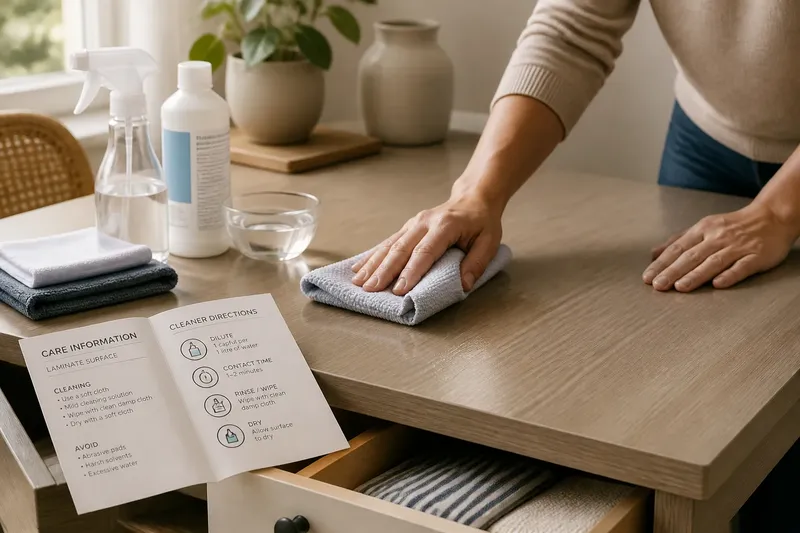
In this invented situation, the table has a manufacturer’s care leaflet tucked into a drawer. It identifies the surface as laminate and advises a soft cloth with mild cleaning solution, followed by a clean, damp wipe. The bottle’s label gives its own directions for dilution and contact time. Those instructions are not interchangeable: one concerns the surface, the other the cleaner.
The household checks both before doing anything else. They set aside the multi-surface product rather than mixing it with another cleaner, and use the mild solution described for the table. A fresh cloth dampened with plain water removes the remaining cleaner, then a dry cloth takes up surface moisture. The expected observable result is a table that no longer feels tacky, without the extra film that had accumulated.
This is not a promise that every sticky finish will respond the same way. If the surface remains tacky after the residue is removed, the finish itself may be affected, or the mark may have another cause. The sensible next move is to consult the maker or a qualified furniture-care professional rather than scrub harder.
What excess leaves behind
Cleaning products work according to their formulation and directions. A larger amount does not necessarily make them more effective. If a product is meant to be diluted, used sparingly or wiped away, excess can remain on the surface. That residue may feel greasy, attract dirt or leave streaks. On fabric, it can also be difficult to rinse out fully with an ordinary wipe.
Extra product can encourage extra effort, too. A person may rub longer because a surface feels slick or because foam makes a mark look as if it is still being lifted. Yet scrubbing can abrade a coating, spread a stain or work moisture into a seam. A soft cloth and a modest amount of suitable cleaner are often easier to control than a saturated sponge.
Think of soap in a drinking glass: adding more does not make the glass cleaner if the soap is left clinging to the sides. The useful part is the right amount, followed by an appropriate rinse or wipe where the instructions call for one. The same principle applies to many household surfaces, though the correct product and finish vary.
Care information first
Care information may appear on a garment tag, a furniture label, a product leaflet or the maker’s website. It can specify whether to use water, which cleaning method is suitable, or which products to avoid. For a removable cushion cover, the label may distinguish between machine washing and spot cleaning. For a coated worktop, the maker may caution against abrasive pads or particular solvents.
Read the item’s guidance alongside the cleaner label. Look for the surface or material the product is intended for, any dilution directions, whether it must be rinsed, and whether it should be left in contact for a stated period. Use only the instructions relevant to that item. If the information is missing or unclear, contact the manufacturer or seek qualified advice where damage could be costly; do not assume that a cleaner labelled “all-purpose” suits every finish.
Product names can also be misleading in everyday use. “Concentrated” describes a formula that may require dilution; it is not an invitation to apply it undiluted. “Disinfecting” describes a particular purpose, not a reason to use it on every surface during routine cleaning. Follow the label and avoid combining cleaning products, since mixtures can create hazards.
How much is enough?
Begin with the least aggressive approach allowed by the care information. For ordinary dust or light soil, a dry or lightly dampened microfibre cloth may be enough. If the surface needs cleaner, apply the amount and method stated on the label rather than pouring freely. A spray bottle can help distribute product, but spraying directly onto electronics, unfinished edges or delicate items may allow liquid into places it should not reach. Spray onto a cloth when the item’s guidance permits that approach.
Give the cleaner its specified contact time if one is required; do not compensate for a short wait by using more. Then rinse or wipe as directed. If a mark remains, pause and identify what it might be before repeating the treatment. Grease, dried food and a dye transfer can call for different responses, while a damaged finish may resemble dirt without being removable soil.
In the table situation, the household notices that the mark disappears with the recommended mild solution, while the tackiness improves only after the old residue is wiped away. That distinction matters: cleaning the mark and removing the cleaner film are separate jobs. Once the table is dry, they use a smaller amount next time and check the surface rather than assuming that a slick feel means it needs another round.
Questions about product use?
Should I use more cleaner on a stubborn mark?
Not automatically. Check whether the product is suitable for the material and whether its label calls for dilution, contact time or rinsing; if the mark persists, stop before adding more or scrubbing harder.
Can I use the same cleaner on every surface?
No single label makes a product suitable for every finish, fabric or coating. Match the cleaner to the item’s care information, and use a different method when the maker advises against that product.
What if the care label is missing?
Look for the maker’s instructions using the item’s brand and model, or ask the manufacturer. Until you know more, avoid strong cleaners, abrasive tools and unapproved solvents, especially on a valuable or delicate finish.
Does more foam mean a better clean?
Foam is not a reliable measure of cleanliness. Use the product as directed, then check whether soil remains and whether the surface needs a clean-water wipe or drying cloth.
A routine with restraint
For the hypothetical household, the result is not a new cleaning system but a small change in judgement: read the table’s care leaflet, follow the cleaner label, and treat residue as a separate issue from dirt. That approach keeps the routine proportionate and makes it easier to notice when a material is reacting badly.
Keep care information where it can be found, perhaps with the household manuals or in a phone note, and record the item’s maker and model if the label is hard to read. When routine cleaning does not resolve a mark, identify the material and ask for suitable advice instead of escalating the dose. More cleaning product does not mean more care; the better measure is whether the chosen method respects the object in front of you.