The Button Jar Before the Spare-Parts Drawer
The button jar and spare-parts drawer show how household reuse keeps small, useful pieces in circulation instead of sending them straight to waste.
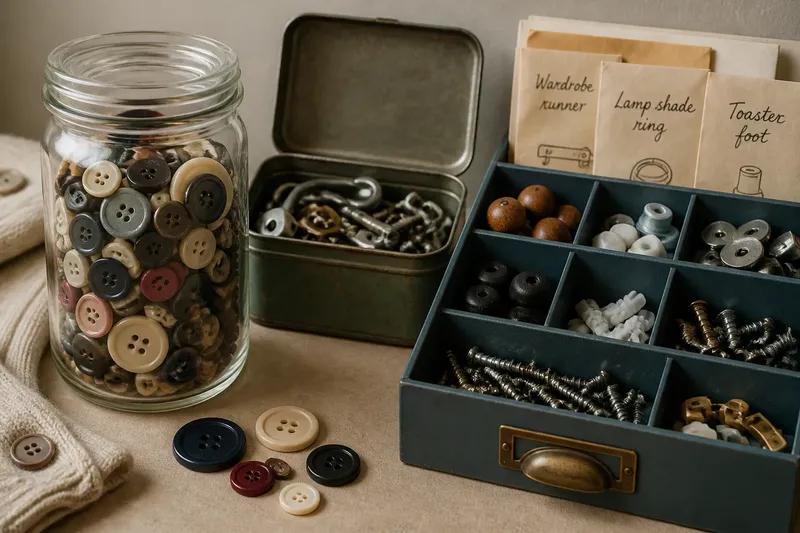
The common mistake with a loose button or spare screw is to treat it as rubbish because its original purpose is no longer obvious. The button jar and spare-parts drawer grew from the opposite habit: keep a small object until a later repair reveals what it can do. That choice saves a useful component from being discarded, but it also asks for a little care in how it is kept and recognised.
Small things, long lives
A button jar is more than a container for sewing supplies. It is a household record of garments altered, coats outgrown and fastenings replaced. Buttons arrive from cuffs and collars, from a cardigan with a damaged seam, or from a shirt whose fabric has worn thin before its buttons have. The jar gathers objects whose first setting has ended but whose usefulness has not.
The same habit extends well beyond clothing. A tin may hold a spare hook, a drawer may contain the rubber feet from an appliance, and a small box may keep a hinge pin or an unused cable clip. In each case, the household is retaining a component rather than the whole item it once belonged to. That distinction is central to making do: the value lies not in keeping everything, but in keeping pieces likely to solve a later, specific problem.
Containers make the practice visible. A jar lets buttons be seen through its sides, while a lidded tin keeps small metal pieces from scattering. The vessel need not be special. A reused food jar, a clean biscuit tin or a divided parts box can all serve, provided the contents stay dry and can be reached without turning the whole collection out.
How the habit grew
Before household goods were routinely treated as easy to replace, many objects were repaired, adjusted or passed on. A missing button could make a garment inconvenient, not useless. A loose screw could leave a stool unstable, while a spare catch might keep a cupboard door working. Retaining a small part made sense because the larger object still had value and repair was an ordinary response to wear.
Keeping these pieces did not require a formal system. A jar near the sewing basket, a tin on a workshop shelf or a box in a kitchen drawer placed the saved parts within reach of the work they might support. The arrangement was often local and practical: buttons together because they were used together, or odd fittings kept near household tools. The storage itself reflected repeated chores rather than a catalogue of every object in the home.
As products became more varied, the collection of spare parts could become less straightforward. A screw from one appliance may not suit another; a clip may look familiar but fit only one model. This did not erase the reuse habit. It changed what was worth saving. The more specific a part, the more useful it is to retain its identity with it, such as the product name, a paper note or the instruction booklet that explains its purpose.
From jar to drawer
The button jar and the spare-parts drawer are related, but they organise belongings differently. Buttons are usually durable, easy to recognise and useful across many garments. A mixed jar can still be productive because a sewer can compare size, colour, shank and number of holes when choosing a replacement.
Household fittings are less forgiving. A drawer full of anonymous screws, washers and plastic caps may look abundant while being difficult to use. Threads differ, shapes can be deceptive, and a small part may belong to a particular appliance. A divided box or a labelled envelope can preserve the link between a part and its source. The aim is not elaborate inventory; it is enough context to prevent a useful object becoming an unidentified speck.
Think of the difference as a bowl of fruit beside a set of keys. The fruit can be recognised at a glance, but keys need labels or a known place because their shapes alone may not reveal what they open. Buttons often behave like the fruit; specialised fittings often behave like the keys. Choosing a container according to how much identification the contents need is more useful than copying one storage style for every small object.
What earns a place?
Saving a part is a decision, not an obligation. A useful question is whether the object has a plausible future role that can be understood without guesswork. A sturdy button with an intact shank has a clear use. A unique plastic tab with no known source may be harder to justify, especially if its material is brittle or its original item has gone.
Useful signs include:
- A recognisable purpose: you know what the part does, or can keep a note that explains it.
- A sound condition: the button is not cracked, the fastener is not badly corroded, and the fitting is not visibly broken.
- A likely match: it belongs to an item still in use, or is a broadly compatible type such as a plain clothing button.
- A manageable quantity: keeping a few suitable pieces is more helpful than holding on to every duplicate without a reason.
- A suitable container: the part can be stored without snagging fabric, escaping through a gap or being mistaken for something else.
These are prompts rather than rules. A spare button from a much-loved coat may be worth keeping even if it is an unusual colour, because an exact match can be difficult to find. A common screw may have little value if its size and source are unknown. Let the likely repair, not the mere fact that the object is small, decide.
Keeping context with parts
One of the subtler features of household reuse is that memory can be part of the stored item. A button is often self-explanatory, but a specialist fitting may lose its usefulness once separated from its source. A label reading “wardrobe runner” or “lamp shade ring” can be enough to bring the connection back. If the precise model matters, keep the part in a labelled envelope with the relevant booklet or a note recording the product name.
Do not assume that all small parts are interchangeable because they look alike. For an appliance, furniture fitting or other product where fit and safe use matter, consult its instructions or the manufacturer’s guidance before using a saved component. Local requirements may also apply to particular repairs; seek a qualified professional where the work involves a safety-critical system.
Say you remove a sound wooden drawer knob while replacing a damaged one. If you put the old knob in an unlabelled tin, its shape may not tell you which drawer it came from or whether its screw will fit elsewhere. If instead you place it in a small envelope marked with the furniture item, the part remains available for reuse and its useful context travels with it.
Why the containers differ
The familiar button jar works because its contents tolerate being stored together. Buttons are usually robust, and seeing a mixture can help when matching a garment. A glass jar also makes the collection visible, though a wide opening is easier to use than a narrow neck. Keeping it somewhere stable and away from damp helps preserve both the container and its contents.
Metal fasteners may call for a dry tin or a divided organiser, particularly when different types would otherwise mingle. Sharp or pointed pieces should not share a loose container with thread, fabric or hands reaching in casually. Small plastic fittings may benefit from being kept away from heat or direct sun if their material is vulnerable. The best choice follows the part’s shape and condition, not an idealised picture of a tidy workshop.
Labels can be modest. A paper slip inside a tin, a folded note in a compartment or a clear mark on an envelope is often enough. Avoid writing a detailed description that takes longer to maintain than the collection itself. If a part cannot be identified after a reasonable look, keeping it indefinitely may turn storage into a burden rather than a resource.
Questions about spare parts?
Should all spare buttons go in one jar?
A mixed jar is useful when buttons are durable and you can recognise likely matches by sight. Keep unusual or garment-specific buttons in a labelled envelope if an exact replacement matters.
What belongs in a spare-parts drawer?
Keep parts with a plausible use and enough context to identify them, such as a known source or a label. Avoid filling the drawer with broken fragments or fittings whose purpose cannot be remembered.
How can I stop small parts getting lost?
Use a container with a secure lid or compartments suited to the pieces, and keep it in a stable, dry place. Label specialised parts so they are not mistaken for anonymous hardware later.
Can I use a saved fitting on another item?
Only if it is an appropriate match and the item’s instructions or manufacturer’s guidance supports that use. Similar appearance alone does not establish that a fitting will fit or function properly.
Reuse with a limit
A household collection works best when it stays small enough to remember and specific enough to use. That does not mean imposing a strict count or clearing out anything unfamiliar. It means noticing whether each saved piece has a likely role, a sound condition and a place where it can be found without disturbing the rest.
The button jar before the spare-parts drawer is a story of changing household needs, but also of a simple distinction: some objects can wait in a mixed collection, while others need their identity kept close. Keep the ordinary, reusable pieces together when they remain easy to recognise; keep specialised parts with their source and instructions. That small act of preserving context is what turns a container of odds and ends back into a resource.