Open Shelves or Closed Boxes for Everyday Supplies?
Open shelves or closed boxes for everyday supplies? Choose a setup that makes essentials easy to notice, reach and put away without clutter.
The most common storage mistake is choosing a container before deciding how an item gets used. Open shelves or closed boxes can both leave everyday supplies hard to find: a crowded shelf hides things behind other things, while an opaque box makes its contents disappear. The cost is small but persistent—extra searching, supplies bought twice and belongings left out because putting them away feels awkward.
Start with the habits around the items, not the furniture. A roll of tape used often, spare batteries kept for occasional need and cloths that must dry after use do not all benefit from the same kind of storage. The useful question is which arrangement makes each item easiest to notice, reach and return.
Begin with the routine
Choose one group of supplies, such as wrapping materials, stationery or household cloths. Gather only the items that belong to that group and set them near the place where they are used. Notice which ones are reached for regularly, which are used together and which can be put away for long stretches.
Do not sort by appearance alone. A neat row of matching containers can still be inconvenient if the scissors are stored away from the paper they cut. A shelf that looks busy may be doing a useful job if its contents are clear and the frequently used items sit within easy reach.
For each item, ask three practical questions:
- Would seeing it prompt a useful action, such as replacing a nearly empty roll of tape?
- Does it need to be picked up quickly, without moving other things first?
- Can it be returned easily after use, even when you are in a hurry?
These answers point towards a storage style. Items that benefit from being seen and handled often usually suit open access. Items used occasionally, or those that look untidy when exposed, may be better contained. Some groups will need both.
Match visibility to use
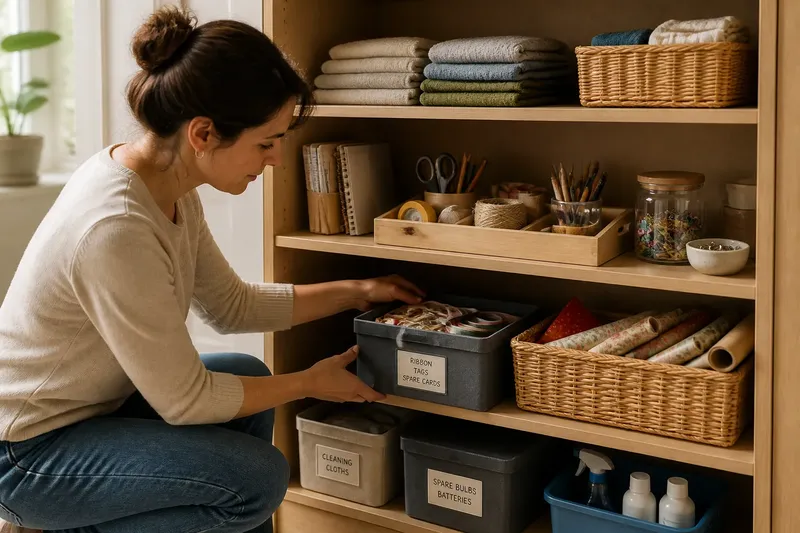
Open shelves make their contents legible at a glance. A shallow shelf beside a desk might hold a notebook, pencils and a small tray for clips. A low shelf in a utility area could keep folded cleaning cloths visible, while leaving space for them to air if they are still damp. Visibility can help you notice what needs restocking and prevent useful supplies from being forgotten.
That advantage depends on restraint. When items are stacked deeply or crowded together, the front row becomes a screen. Keep the shelf’s purpose narrow, group related things in a tray, and leave enough room to lift an item without shifting its neighbours. A small basket on an open shelf can contain loose pieces while keeping the group visible; it is not necessary to expose every individual object.
Closed boxes offer a different kind of clarity. They make a shelf or cupboard look calmer and keep small objects together. A lidded box can suit spare wrapping ribbon, seasonal stationery or replacement parts that are not needed every day. It can also protect contents from dust, sunlight or household knocks, depending on the material and where the box is kept.
The trade-off is that a closed box asks you to remember what it contains. A clear box makes the contents visible but may still obscure items at the bottom. An opaque box can be tidier to look at, yet needs a clear label. Choose the simplest container that solves the actual problem rather than adding a box to every category.
Choose the right access
Compare how each option behaves during an ordinary task. Imagine a household keeping gift wrap, scissors, tape and spare cards in a cupboard. If the scissors and tape are used whenever a parcel is wrapped, they could sit together in an open tray on a reachable shelf. The spare cards and ribbons, used less often, could go in a labelled box below. The expected result is that the active tools are easy to spot and return, while the less-used materials stay contained.
Use the same logic for other supplies. Keep the items used together close together, but do not force unlike things into one container merely because they share a cupboard. A box labelled “desk supplies” may be too broad if it mixes ink cartridges, sticky notes and tools used in different places. More specific labels make a box useful without turning its contents into a puzzle.
Consider the path from storage to use and back again. A container that is awkward to lift or has a lid that needs two hands can discourage putting things away. On a high shelf, a lightweight box may be more manageable than a heavy one. Near a work surface, an open tray may be easier to return to than a stack of lidded containers. Keep frequently handled items within comfortable reach; place seldom-used supplies further away if that suits the household.
For loose items, compare a shallow tray with a deeper box. A shallow tray makes small contents easier to scan, but can become crowded and spill when moved. A deeper box contains more, yet the bottom can become hard to reach. If a group needs both containment and visibility, consider a box with internal dividers or several small, labelled containers inside it.
Check the storage place
The room matters as much as the container. Open shelves collect visible dust and leave contents exposed to light and everyday contact. In a busy hallway, a box may prevent gloves or spare light bulbs from being knocked about. In a cupboard that is opened rarely, labels can do more for retrieval than a clear lid.
Think about the supply itself. Paper and fabric can be affected by damp or direct sunlight; metal pieces may need to stay dry; items with sharp edges should be contained so they do not catch on nearby things. Avoid placing everyday supplies where they obstruct a doorway, a work surface or another household task. For product-specific storage needs, follow the item’s label or manufacturer’s instructions.
Before committing, try the arrangement with what you already own. A sturdy tray, a reused shoebox or a shelf divider can help you judge whether the contents are easy to see and return. Do not buy a set of matching boxes until you know how many separate groups the supplies naturally form. A container should fit the items and the storage space, rather than making you reshape the household routine around it.
Make putting away easy
Retrieval gets attention because it is noticeable when something is missing. Returning an item is just as important. If a pair of scissors has a clear place beside the paper, it is more likely to go back there than into a general drawer. If a box must be pulled from behind other boxes, opened, searched and repacked for a frequently used item, the arrangement is asking too much of an ordinary routine.
Give each group a sensible boundary. A tray can stop pens from spreading across a desk; a labelled box can keep spare envelopes together. Leave some room for the group to change, but avoid making one container a catch-all for anything that lacks a home. When a category grows, separate it by use or location rather than adding another vague label.
Use labels that answer the question you would ask while looking for something. “Batteries” is clearer than “small bits”; “spare envelopes” is clearer than “paper”. If several people use the same storage area, choose plain words everyone understands and put the label where it can be seen without moving the container.
Which option fits best?
Are open shelves better for things used every day?
They can be, especially when the items are tidy, durable and easy to return. Keep the shelf uncrowded and place the most frequently used supplies where you can reach them without shifting other objects.
When should everyday supplies go in closed boxes?
Use a box when keeping a group together or shielding it from dust and disturbance matters more than seeing each item. For an opaque box, add a direct label so you do not have to open several containers to find the right one.
Are clear boxes a good compromise?
They can show what is inside while containing loose items, but contents at the back or bottom may still be hard to identify. A short label or divider can make the arrangement easier to scan.
Can shelves and boxes work together?
Yes. Keep active supplies visible on an open shelf and use labelled boxes for related items that are used less often. The combination works best when each container has a distinct purpose rather than duplicating what is already on display.
Review the arrangement
After using the setup for a while, notice where supplies accumulate. An item repeatedly left on the work surface may need a closer or more obvious home. A box that is opened only to search through an overfull collection may need a clearer division. Adjust the storage, not the label alone, if the contents are difficult to reach.
Open shelves or closed boxes are not competing rules for the whole household. They are options for different routines: shelves favour quick sight and access, while boxes contain, group and protect. Start with the supplies that interrupt a task most often, give them a home that is easy to use in both directions, and let the rest of the arrangement follow from what you observe.
The best final check is simple: after taking one item out, can you put it back without clearing space or deciding anew where it belongs? If the answer is yes, the storage is doing its quiet work, whether the home is a shelf, a box or both.